2026 Student Aid Index Changes: Pell Grant Eligibility for 4-Person Households
Anúncios

Navigating college tuition just got a whole lot different for American families. Understanding the latest 2026 Student Aid Index Changes is critical, as updated federal formulas directly alter how financial need and grant allocations are measured across the country.
For 4-person households, these revamped financial aid metrics create clear income thresholds for federal support. Shifting away from legacy calculation models means household size and adjusted gross income now play a far more decisive role in securing full funding.
These modern evaluation criteria ultimately determine whether four-member families qualify for maximum tuition relief or miss out on vital aid. Here is what you need to know about the updated math to maximize your household’s college funding.
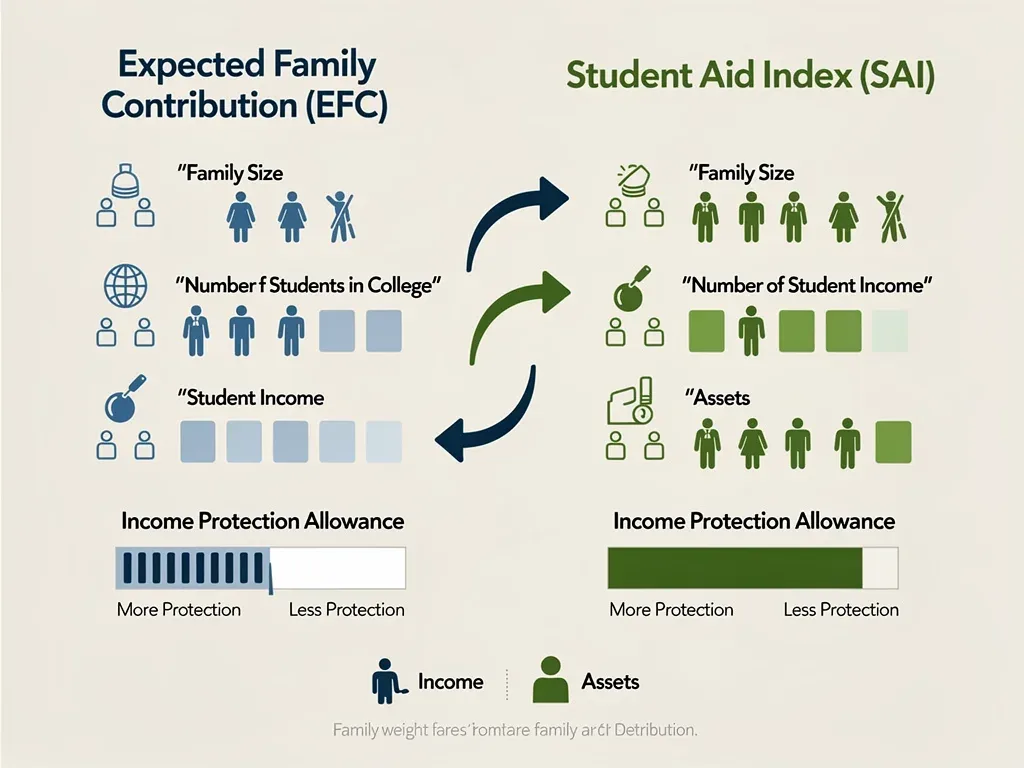
Understanding the Shift from EFC to Student Aid Index (SAI)
The transition from the Expected Family Contribution (EFC) to the Student Aid Index (SAI) represents a pivotal change in how federal student aid is determined. This new methodology aims to provide a more accurate and equitable assessment of a family's ability to pay for college, moving away from a system that often left many families feeling overlooked.
For 4-person households, this change means a fresh look at their financial profile, including income, assets, and household size, under a new set of rules. The goal is to simplify the process while potentially expanding Pell Grant eligibility for a broader range of students, though individual outcomes will vary.
Anúncios
This section will delve into the core differences between the EFC and SAI, setting the stage for a detailed examination of how the 2026 Student Aid Index specifically impacts Pell Grant opportunities for families with two parents and two dependents.
Key Changes in the 2026 Student Aid Index Formula
The 2026 Student Aid Index formula introduces several significant modifications that directly influence a family's calculated financial need. These changes are designed to streamline the application process and offer a clearer picture of a family's economic standing, but they also require careful attention from applicants.
Among the most notable adjustments are alterations to income protection allowances and the treatment of family businesses and farms. These elements, previously handled differently, now play a distinct role in determining the SAI, which can significantly alter a 2026 Student Aid Index outcome.
Anúncios
Moreover, the new formula eliminates the benefit for families with multiple children in college simultaneously, a change that will profoundly affect many 4-person households. This particular aspect of the 2026 Student Aid Index has generated considerable discussion and concern among financial aid experts and families alike.
Income Protection Allowances and Their Impact
The revised income protection allowances under the 2026 Student Aid Index are designed to shield a greater portion of a family's income from being considered available for college expenses. This adjustment aims to ensure that families have sufficient funds for basic living expenses before contributing to higher education costs.
For a 4-person household, these new allowances could mean a lower SAI, potentially increasing their eligibility for need-based aid, including the Pell Grant. The updated figures reflect a more realistic view of household expenses, which is a welcome change for many.
Increased income protection allowances for parents and students.
Adjustments based on inflation and cost of living.
Designed to leave more disposable income for family needs.
Treatment of Family Businesses and Farms
Another critical change in the 2026 Student Aid Index formula involves how family businesses and farms are assessed. Previously, these assets were often counted against families, sometimes disproportionately impacting their aid eligibility. The new regulations aim to address this imbalance.
The FAFSA Simplification Act now excludes the value of small family businesses and farms from asset calculations, provided certain conditions are met. This change is particularly beneficial for 4-person households whose primary livelihood is tied to these assets, preventing them from being penalized for their entrepreneurial endeavors.
Exclusion of small business and farm equity from asset calculations.
Aims to support agricultural and entrepreneurial families.
Requires specific criteria to be met for exclusion.
Pell Grant Eligibility Criteria Under the New SAI
Pell Grant eligibility is directly tied to a student's calculated Student Aid Index (SAI), with a lower SAI generally correlating to higher eligibility for aid. The 2026 Student Aid Index changes will redefine the parameters for who qualifies for this crucial federal grant.
For 4-person households, understanding how their specific financial situation translates into an SAI is critical for anticipating Pell Grant awards. The new formula emphasizes adjusted gross income (AGI) and household size, among other factors, to determine eligibility more precisely.
The maximum Pell Grant award will continue to be a significant component of financial aid packages, and the 2026 Student Aid Index aims to direct these funds to those with the greatest demonstrated need, potentially expanding access for some while shifting eligibility for others.
Maximum Pell Grant Eligibility and SAI Relationship
The maximum Pell Grant award is available to students with an SAI of zero or even a negative SAI, indicating the highest level of financial need. The 2026 Student Aid Index formula is designed to identify these students more accurately, potentially increasing the number of recipients of the full award.
For 4-person households, achieving a low SAI is key to maximizing Pell Grant opportunities. This involves careful consideration of all financial inputs on the FAFSA, ensuring that all eligible exclusions and allowances are properly accounted for.
The relationship between SAI and Pell Grant eligibility is linear: as SAI decreases, the Pell Grant amount generally increases, up to the maximum award. This direct correlation makes understanding the 2026 Student Aid Index crucial for financial planning.
Specific Impact on 4-Person Households
The FAFSA Simplification Act's changes, particularly the elimination of the multiple-children-in-college discount, will have a distinct impact on 4-person households. This adjustment means that each child's SAI will be calculated independently, without the previous reduction for siblings attending college simultaneously.
Historically, families with two children in college at the same time saw their EFC divided by two, effectively doubling their eligibility for need-based aid. Under the 2026 Student Aid Index, this benefit is removed, potentially leading to a higher calculated SAI for each student from the same household.
This particular change will necessitate a re-evaluation of financial strategies for many 4-person households, as the overall federal aid package may be less generous than under the previous system. Families must proactively understand these implications for the 2026 Student Aid Index.
Loss of Multiple-Child Discount and Its Repercussions
The elimination of the multiple-child discount is arguably one of the most significant changes for 4-person households with two college-bound children. This adjustment means that the financial burden for two students attending college simultaneously will now be assessed differently, without the previous aid advantages.
Families accustomed to receiving more aid when multiple children were enrolled will now find that each child's financial need is evaluated as if they were an only child in college. This will directly influence how the 2026 Student Aid Index is calculated for each student, potentially reducing their Pell Grant eligibility.
The repercussions extend beyond just Pell Grants, affecting other forms of need-based federal and institutional aid. 4-person households should prepare for this shift in how the 2026 Student Aid Index impacts their overall financial aid landscape.
Strategies for 4-Person Households to Maximize Pell Grant Eligibility
Despite the changes, 4-person households can still employ strategic approaches to maximize their Pell Grant eligibility under the 2026 Student Aid Index. Proactive planning and a thorough understanding of the new FAFSA are essential for navigating these reforms effectively.
One key strategy involves careful management of income and assets in the years leading up to college enrollment. Understanding which assets are counted and which are excluded can make a substantial difference in the calculated SAI, thereby influencing Pell Grant eligibility.
Additionally, seeking professional financial aid advice can provide personalized guidance tailored to a family's unique situation, helping them optimize their financial profile for the 2026 Student Aid Index and other forms of aid.
Proactive Financial Planning and Asset Management
For 4-person households, proactive financial planning is more critical than ever. This includes understanding the FAFSA's look-back period for income and strategically managing assets that are considered in the SAI calculation. Investments in tax-advantaged retirement accounts, for instance, are generally not counted.
Families should also be aware of the impact of withdrawals from 529 plans, especially if they are not used for qualified educational expenses, as these could affect future SAI calculations. The goal is to present the most favorable financial picture possible when applying for aid under the 2026 Student Aid Index.
Prioritize retirement savings over taxable investment accounts.
Understand the FAFSA's asset exclusion rules for small businesses and farms.
Plan for income fluctuations in the base year used for FAFSA.
Understanding the New FAFSA and Seeking Expert Advice
The redesigned FAFSA form itself is simpler, but understanding the underlying calculations of the 2026 Student Aid Index remains complex. Families should familiarize themselves with the new terminology, such as SAI, and how their specific financial data will be interpreted.
Seeking advice from a qualified financial aid advisor or college planner can provide invaluable insights. These professionals can help 4-person households navigate the complexities of the new system, identify potential pitfalls, and ensure they are maximizing their eligibility for all available aid, including Pell Grants, under the 2026 Student Aid Index.
Review the new FAFSA form well in advance of application deadlines.
Consult with financial aid offices at prospective colleges.
Consider professional financial planning services for personalized guidance.
Broader Implications for Higher Education Funding
The implementation of the 2026 Student Aid Index and the FAFSA Simplification Act extends beyond individual family impacts, signaling broader shifts in higher education funding. These changes are part of a larger effort to make college more affordable and accessible, but their full effects will unfold over time.
Institutions of higher education are also adapting their financial aid strategies in response to the new federal guidelines. This includes re-evaluating their own need-based aid formulas and how they complement federal programs like the Pell Grant, which is significantly influenced by the 2026 Student Aid Index.
Policymakers will continue to monitor the outcomes of these reforms, potentially adjusting aspects of the 2026 Student Aid Index as data emerges on its impact on student enrollment, retention, and equity in access to higher education.

Navigating the 2026 Student Aid Index for Future Planning
As the 2026 academic year approaches, 4-person households must proactively engage with the new financial aid landscape shaped by the 2026 Student Aid Index. This involves not only understanding the changes but also incorporating them into long-term educational and financial planning.
The shift from EFC to SAI, combined with the elimination of the multiple-child discount, underscores the need for continuous awareness and adaptation. Families should regularly consult official Department of Education resources and college financial aid offices for the most up-to-date information regarding the 2026 Student Aid Index.
Ultimately, successful navigation of these reforms will depend on a combination of informed decision-making, strategic financial management, and a willingness to adapt to the evolving requirements of federal student aid, particularly concerning the 2026 Student Aid Index.
Key Change | Brief Description |
|---|---|
EFC to SAI Transition | Expected Family Contribution replaced by Student Aid Index for calculating need. |
Income Protection | Increased allowances to protect more family income from aid calculations. |
Multiple-Child Discount | Eliminated, impacting 4-person households with multiple college students. |
Asset Treatment | Exclusion of small family business/farm equity from asset assessment. |
Frequently Asked Questions About the 2026 Student Aid Index
What is the primary change introduced by the 2026 Student Aid Index?▼
The primary change is the replacement of the Expected Family Contribution (EFC) with the Student Aid Index (SAI). This new formula, part of the FAFSA Simplification Act, redefines how a family's financial need is assessed for federal student aid, including Pell Grants.
How does the 2026 Student Aid Index affect 4-person households with two college students?▼
For 4-person households with two college students, the most significant impact is the elimination of the multiple-child discount. This means each child's SAI will be calculated independently, potentially leading to less overall federal aid compared to the previous system.
Will the 2026 Student Aid Index make Pell Grants more accessible?▼
The 2026 Student Aid Index aims to expand Pell Grant eligibility for more students, particularly those with the highest financial need, by increasing income protection allowances and simplifying the FAFSA. However, specific outcomes will vary by individual family circumstances.
What are income protection allowances under the new SAI?▼
Income protection allowances are amounts of income that are protected from being counted in the SAI calculation. Under the 2026 Student Aid Index, these allowances have been increased to ensure families retain more income for basic living expenses before contributing to college costs.
What steps should 4-person households take to prepare for the 2026 Student Aid Index changes?▼
4-person households should familiarize themselves with the new FAFSA and SAI formula, manage assets strategically, and consider seeking advice from financial aid professionals. Proactive planning is crucial to understanding potential Pell Grant eligibility and maximizing aid.
What this means
The overhaul of federal student aid through the 2026 Student Aid Index represents a fundamental shift for families planning for college. While designed to simplify and improve equity, the changes, especially for 4-person households, necessitate a deep understanding of the new FAFSA.
Families must adjust their financial planning and expectations for Pell Grant eligibility, continuously monitoring official updates and seeking expert guidance to navigate these significant reforms effectively.