High-Yield Savings vs. Treasury Bills: 4.8% APY Now
Anúncios
Is your cash sitting in an account that barely keeps up with inflation? Navigating the battle of High-Yield Savings vs. Treasury Bills is essential if you want to capture peak 4.8% yields without taking on market risk.
While online deposit accounts offer liquid access and FDIC safety net protection, short-term government debt instruments allow you to lock in guaranteed returns fixed against unexpected rate cuts. Furthermore, federal backed securities boast state and local tax exemptions that can deliver a higher net payout depending on your tax bracket.
Choosing the right landing spot for your emergency fund or idle cash comes down to how soon you need the funds. Read on for a side-by-side strategy breakdown to ensure every dollar works at maximum capacity.
Understanding High-Yield Savings Accounts in Today's Market
High-Yield Savings Accounts (HYSAs) have emerged as a significant option for individuals seeking competitive returns on their liquid assets. These accounts, typically offered by online banks, provide annual percentage yields (APYs) substantially higher than traditional savings accounts.
Currently, many HYSAs are offering APYs around the 4.8% mark, making them an attractive proposition for those looking to maximize their savings without taking on significant risk. This makes the discussion of High-Yield Savings Accounts vs. 12-Month Treasury Bills particularly relevant for investors.
Anúncios
The appeal of HYSAs lies in their liquidity and the ease of access to funds, which is a crucial factor for emergency savings or short-term financial goals. Their competitive rates reflect the current interest rate environment, influenced by Federal Reserve policies.
The Landscape of 12-Month Treasury Bills
12-Month Treasury Bills, often referred to as T-Bills, represent short-term debt obligations issued by the U.S. Department of the Treasury. These securities are sold at a discount and mature at their face value, with the difference representing the investor's return.
T-Bills are widely considered among the safest investments due to the full faith and credit backing of the U.S. government, virtually eliminating default risk. The yields on 12-Month Treasury Bills have also been hovering around 4.8% recently, prompting a direct comparison with HYSAs.
Anúncios
Investors typically purchase T-Bills through TreasuryDirect, brokers, or banks, providing a straightforward way to invest in government-backed securities. Their predictable returns and safety profile make them a cornerstone for conservative investment strategies.
When evaluating High-Yield Savings Accounts vs. 12-Month Treasury Bills, the primary considerations often revolve around safety, liquidity, and tax implications. Both offer compelling reasons for investors to consider them in their portfolios.
Key Differences: Liquidity and Access to Funds
One of the most significant distinctions between High-Yield Savings Accounts and 12-Month Treasury Bills is their liquidity. HYSAs offer immediate access to funds, typically allowing unlimited withdrawals or transfers, though some online banks may have transaction limits.
Conversely, 12-Month Treasury Bills are less liquid as they are fixed-term investments. While they can be sold on the secondary market before maturity, doing so might incur transaction fees or result in a loss if interest rates have risen since purchase. This difference is critical for individuals needing flexible access to their capital.
For emergency funds or short-term savings where immediate access is paramount, HYSAs often present a more suitable option. For funds that can be locked away for a year, T-Bills provide a guaranteed return with exceptional safety.
Withdrawal Flexibility and Penalties
High-Yield Savings Accounts generally allow easy withdrawals without penalties, though some may have daily limits.
Treasury Bills mature at a specific date, and selling them early on the secondary market can involve market risk and transaction costs.
The flexibility offered by HYSAs makes them ideal for funds that might be needed unexpectedly, contrasting with the fixed nature of T-Bills.
Understanding the implications for High-Yield Savings Accounts vs. 12-Month Treasury Bills on liquidity is vital for aligning your investment choice with your financial needs and time horizon.
Tax Implications for Your Earnings
The tax treatment of earnings from High-Yield Savings Accounts and 12-Month Treasury Bills differs significantly, an important factor for investors to consider. Interest earned from HYSAs is generally subject to federal, state, and local income taxes.
In contrast, income generated from 12-Month Treasury Bills is exempt from state and local income taxes, though it remains subject to federal income tax. This tax advantage can make T-Bills more appealing, especially for residents in states with high income tax rates.
The tax-exempt status at the state and local levels can lead to a higher after-tax return for T-Bills compared to HYSAs, even if their nominal APYs are similar. Investors should consult with a tax professional to understand the full impact on their personal financial situation.
Federal vs. State and Local Taxes
High-Yield Savings Account interest is taxed at all levels: federal, state, and local.
12-Month Treasury Bill interest is only subject to federal income tax, offering state and local tax exemption.
This tax differential can significantly influence the net return when comparing High-Yield Savings Accounts vs. 12-Month Treasury Bills, particularly for those in high-tax states.
Considering the tax implications is a crucial step in deciding between these two investment vehicles, as it directly impacts your overall financial gain.
Safety and Government Backing
Both High-Yield Savings Accounts and 12-Month Treasury Bills are considered very safe investment options, but their backing mechanisms differ. HYSAs offered by FDIC-insured banks are protected by the Federal Deposit Insurance Corporation up to $250,000 per depositor, per bank, for each account ownership category.
This FDIC insurance provides a robust safety net for depositors, ensuring that their funds are protected even if the bank fails. It's a key reason why HYSAs are trusted for accessible savings.
12-Month Treasury Bills, on the other hand, are backed by the full faith and credit of the U.S. government. This means they are essentially free of default risk, making them one of the safest investments available globally. The inherent safety of both options is a major draw for conservative investors.
Understanding Insurance and Guarantees
FDIC insurance covers High-Yield Savings Accounts up to $250,000 per depositor, offering significant protection.
Treasury Bills are backed by the U.S. government, making them virtually risk-free from default.
The robust backing for both options reassures investors regarding the security of their principal, a key factor in the High-Yield Savings Accounts vs. 12-Month Treasury Bills debate.
The high level of security associated with both HYSAs and T-Bills underscores why they are favored by individuals prioritizing capital preservation.
Current APY and Yield Environment (4.8%)
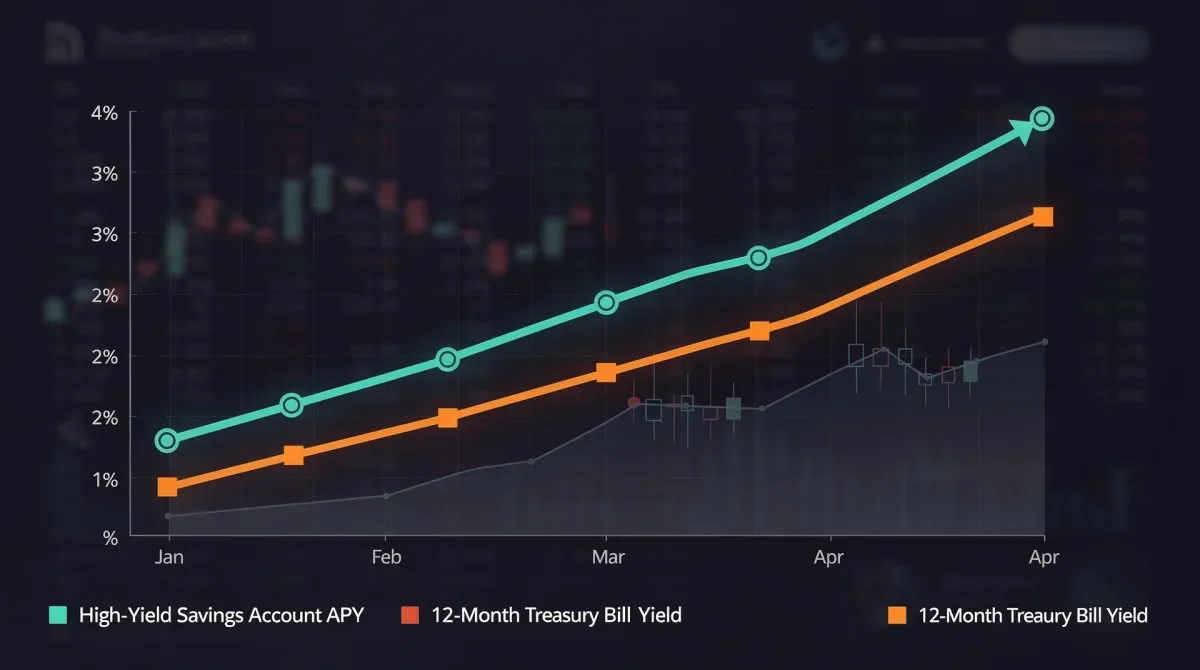
The current financial climate, characterized by elevated interest rates, has made both High-Yield Savings Accounts and 12-Month Treasury Bills particularly attractive, with many offering around 4.8% APY or yield. This competitive rate environment is largely a result of the Federal Reserve's monetary policy aimed at combating inflation.
Investors are now presented with a unique opportunity to lock in substantial returns on their cash, far surpassing what was available just a few years ago. This makes the decision between High-Yield Savings Accounts vs. 12-Month Treasury Bills even more critical, as both offer compelling returns.
Monitoring the Federal Reserve's future decisions on interest rates is crucial, as these policies directly influence the APYs and yields offered by both HYSAs and T-Bills. A shift in policy could impact future rates, making current opportunities valuable.
Factors Influencing Rates
Federal Reserve policy and the federal funds rate significantly impact both HYSA APYs and T-Bill yields.
Market demand for safe assets can also influence T-Bill yields, especially during periods of economic uncertainty.
Competition among online banks drives up HYSA rates, as institutions vie for deposits in a high-rate environment.
The present 4.8% rate for both options emphasizes the importance of understanding the underlying market dynamics when choosing between High-Yield Savings Accounts vs. 12-Month Treasury Bills.
Who Should Consider High-Yield Savings Accounts?
High-Yield Savings Accounts are ideal for individuals who prioritize liquidity, ease of access, and FDIC insurance for their emergency funds or short-term savings goals. They are perfect for parking cash that might be needed at a moment's notice, without sacrificing competitive returns.
Those saving for a down payment on a house, a new car, or any other large purchase within the next year or two will find HYSAs particularly beneficial. The ability to withdraw funds without penalty offers peace of mind and flexibility.
Furthermore, individuals who prefer a straightforward, low-maintenance savings solution will appreciate the simplicity of HYSAs. The comparison of High-Yield Savings Accounts vs. 12-Month Treasury Bills for these use cases often leans towards HYSAs.
HYSAs are a strong choice for those who need a balance of strong returns and immediate accessibility for their cash reserves.

Who Should Consider 12-Month Treasury Bills?
12-Month Treasury Bills are best suited for conservative investors seeking maximum safety and a guaranteed return over a fixed period, typically one year. They are an excellent option for funds that are not needed immediately and can be locked away for the specified term.
Investors looking to diversify their portfolios with ultra-safe assets, or those in high-income tax states who can benefit from the state and local tax exemption, will find T-Bills appealing. They offer a predictable income stream without market volatility.
T-Bills are also a preferred choice for individuals who want to preserve capital and earn a respectable return without exposure to credit risk. When weighing High-Yield Savings Accounts vs. 12-Month Treasury Bills, the fixed term and tax benefits often sway investors towards T-Bills for specific financial objectives.
Ideal Scenarios for T-Bills
Saving for a known future expense exactly one year out, ensuring capital preservation and a fixed return.
Diversifying a portfolio with extremely low-risk assets to balance out more volatile investments.
Benefiting from state and local tax exemptions, especially for high-income earners in high-tax states.
For those with a clear time horizon and a strong preference for government-backed security, T-Bills present a compelling investment choice.
Making Your Decision: High-Yield Savings Accounts vs. 12-Month Treasury Bills
The choice between High-Yield Savings Accounts vs. 12-Month Treasury Bills ultimately depends on individual financial goals, liquidity needs, and tax situation. Both offer competitive 4.8% APYs or yields in the current market, making them attractive options for cash management.
For immediate access and flexibility, HYSAs are generally superior, backed by FDIC insurance. For guaranteed returns, federal government backing, and state/local tax advantages on funds you can commit for a year, T-Bills hold an edge.
It is crucial to assess your personal financial circumstances, including your emergency fund needs, future spending plans, and tax bracket, before deciding. Carefully consider what each option brings to your portfolio.
Feature | Description |
|---|---|
Liquidity | HYSAs offer high liquidity; T-Bills are fixed-term, less liquid. |
Safety | HYSAs are FDIC-insured; T-Bills are U.S. government-backed. |
Tax Treatment | HYSA interest is fully taxable; T-Bill interest is state/local tax-exempt. |
Current Return | Both offer competitive rates around 4.8% APY/yield. |
Frequently Asked Questions About High-Yield Savings and Treasury Bills
What is the main advantage of a High-Yield Savings Account?▼
The primary advantage of a High-Yield Savings Account is its high liquidity combined with competitive interest rates. You can easily access your funds when needed without penalties, making it ideal for emergency savings or short-term goals. Plus, they are typically FDIC-insured up to $250,000.
Why might someone choose 12-Month Treasury Bills over a HYSA?▼
Investors often choose 12-Month Treasury Bills for their unparalleled safety, backed by the U.S. government, and their state/local tax exemption on earnings. For those who can lock up their funds for a year and reside in high-tax states, T-Bills can offer a higher after-tax return.
Are the 4.8% APY/yields guaranteed for both options?▼
For 12-Month Treasury Bills, the yield is locked in at the time of purchase for the full term. For High-Yield Savings Accounts, the APY can fluctuate with market interest rates, though many banks strive to remain competitive. Always check current rates for High-Yield Savings Accounts vs. 12-Month Treasury Bills.
How do I purchase 12-Month Treasury Bills?▼
You can purchase 12-Month Treasury Bills directly from the U.S. Treasury through TreasuryDirect.gov, or through a bank or brokerage account. It's a straightforward process, and you can set up recurring purchases for convenience. This makes comparing High-Yield Savings Accounts vs. 12-Month Treasury Bills accessible.
What should I consider before deciding between these two?▼
Before deciding between High-Yield Savings Accounts vs. 12-Month Treasury Bills, consider your liquidity needs, time horizon for the funds, and your individual tax situation. Evaluate whether you need immediate access to your money or if you can commit it for a year to maximize after-tax returns.
What This Means
The ongoing discussion around High-Yield Savings Accounts vs. 12-Month Treasury Bills underscores a critical moment for personal finance, with both options offering attractive 4.8% APYs. As interest rates remain elevated, understanding the nuances of liquidity, tax implications, and government backing is paramount.
Investors must align their choice with their specific financial goals and risk tolerance, recognizing that market conditions can shift. Continuous monitoring of Federal Reserve actions and prevailing rates will be essential for optimizing returns and making informed decisions in this dynamic financial landscape.